

Which Pass Catcher Should we Draft on the Chicago Bears?
Part 2 of my series on drafting players from ambiguous pass catching groups

This weekend I released Part 1 of a series focused on ambiguous pass-catcher depth charts. If you missed it, please take a read through the below article in which I analyzed the performance of players in ambiguous pass-catcher rooms over the past five seasons, in order to decipher any potential trends that could guide us in choosing from among this year’s crop.
Should we Invest in Ambiguous Pass Catcher Depth Charts?

Hello folks and welcome back to Thinking About Thinking’s fantasy football coverage. Earlier this week we took a brief break from such matters to talk about the Jaylen Brown trade in a free post I’d encourage everyone to check out! But now it’s time to get back to our bread and butter: fantasy football!
I defined an “ambiguous pass-catcher depth chart” as a group of three or more wide receivers or tight ends on the same team, who all have an ADP between Rounds 3-10.
To briefly summarize, these were the most important takeaways from the past data:
Betting on pass catchers from ambiguous rooms is not a floor-raising endeavour, but it can produce a major ceiling. So bet on players you think have a path to that major ceiling rather than betting on the cheapest option unless you think they have the best profile.
Both older players and younger players have hit from ambiguous pass-catching depth charts, but veteran hits have often been drafted earlier overall and within their pass-catching rooms.
If you’re betting on a player in an ambiguous pass-catcher room, you should be projecting either strong team passing volume or elite passing efficiency. Relatedly, you can bet on multiple pass-catchers from the same offense if you expect them to be part of an elite passing game.
As an experimenting in shorter, faster content delivery, I’ve decided to release the team-by-team portions of this series one at a time rather than all at once. Today we focus on one of the most hotly-debated pass catcher groups in the NFL — the Chicago Bears.
The Three Bears
Luther Burden III — Underdog ADP: 42.9 (WR21)
Colston Loveland — Underdog ADP: 47.4 (TE3)
Rome Odunze — Underdog ADP: 60.0 (WR30)

Overview
The Bears trio of pass catchers is perhaps the most hotly debated room in this seris and for good reason. Compared to every other team I’ll write about and every team included in the 2021-2025 data analyzed last article, the 2026 Bears boast the tightest ADP differential between their three top-pass catchers and the earliest ADP for their third pass catcher.
The market has a uniquely high level of excitement for the Bears offense compared to most other teams who fit this criteria, as well as a unique level of uncertainty regarding the pass-catcher hierarchy.
That makes plenty of sense given how little we’ve actually seen of this pass-catcher unit as it stands now. Luther Burden III and Colston Loveland were each rookies in 2025 and were brought on slowly in the first half of the season behind veterans Odunze, D.J. Moore, Olamide Zaccheaus and Cole Kmet.
Luther Burden III ran 20 routes for the first time in Week 10, running between 50-70% of the team’s routes in each of the remaining games.
Colston Loveland was also in a rotational role for the first 7 weeks, but got his first chance at a full-time role due to Cole Kmet’s injury in Week 8. He had a breakout game one week later vs. the Bengals and gradually increased his playing time over the remainder of the season, finally emerging as a true every-down player at the end of the year.
Rome Odunze started his sophomore campaign red hot, but faded over the second half while playing through and eventually missing time with a stress fracture in his foot.
Everyone has their favourite splits they can point to which favour their preferred option to draft. But the reality is, there’s very little we know for certain about how things will look between these three in 2026. Because of all the moving parts in this offense, we never saw Burden and Loveland playing full-time roles at the same time Odunze was fully healthy. And we certainly never saw these three play together without D.J. Moore, who has since been traded to Buffalo.
The Trends
If you’re looking to bet big on one ore more of the Chicago Bears pass catchers in 2026 biggest red flag is the team level passing environment.
Remember, 12 of the 14 hits from ambiguous pass-catching groups in 2021-2025 came from teams that finished top-10 is total pass attempts or top-two in yards per pass attempt.
The Bears did finish 6th in total pass attempts in 2025. However, there are worrying signs they may not be likely to replicate that going forward. Chicago ranked just 22nd in the NFL with a -3.9% PROE last season. The number one driver of their total pass volume was the fact they ranked 2nd in the NFL in total offensive plays per game.
Pace is partly based on repeatable factors. Chicago had the 5th-fastest seconds per play and Ben Johnson was one of the most aggressive coaches in the league on 4th-downs. This combination is favourable for play volume since the team is willing to extend possessions and run plays quickly.
However, there is an element to play volume which is dependent on randomness and game flow. The Bears had a league-leading six 4th-quarter comebacks in 2025. Teams can rack up a ton of pass plays in a very short time in late-game trailing situations, and the fact the Bears were so successful at sustaining drives in these situations to complete comebacks meant they were generating a lot of excess drop backs you probably shouldn’t expect to see in a more typical season. A modest regression in play volume without a change in PROE would render Chicago closer to league average in pass plays than rather than top-10.
Chicago was also 14th in the NFL in YPA despite Caleb Williams playing the entire season. If there is a regression in team passing volume, we’ll need to see a significant spike in his passing efficiency to make up for it. Fortunately, that’s something I’m fairly optimistic about. Caleb Williams was an elite prospect now going into his third season and Ben Johnson led three consecutive offenses between 2022-2024 which finished top-six in passing YPA. In their second season together, paired with ascending young weapons, I think it’s reasonable to project a significant efficiency jump in 2026. Drafted just need to be aware that it’s already priced in.
Moving away from team-level trends I think there’s more to like here. A major takeaway from my last article was to focus on high-ceiling profiles since the base hit rate from these crowded pass rooms is poor, but the ceiling outcomes can be extremely impactful. To that end, most of the biggest hits were either rookies, young players with strong early-career ceiling indicators, or veterans with a past history of elite results. All three of these players are entering year 2 of year 3 and have strong college profiles. Depending on what you emphasize in your analysis, you may have differing views on whose ceiling profiles as the most enticing based on their NFL sample thus far.
The Candidates
Luther Burden III
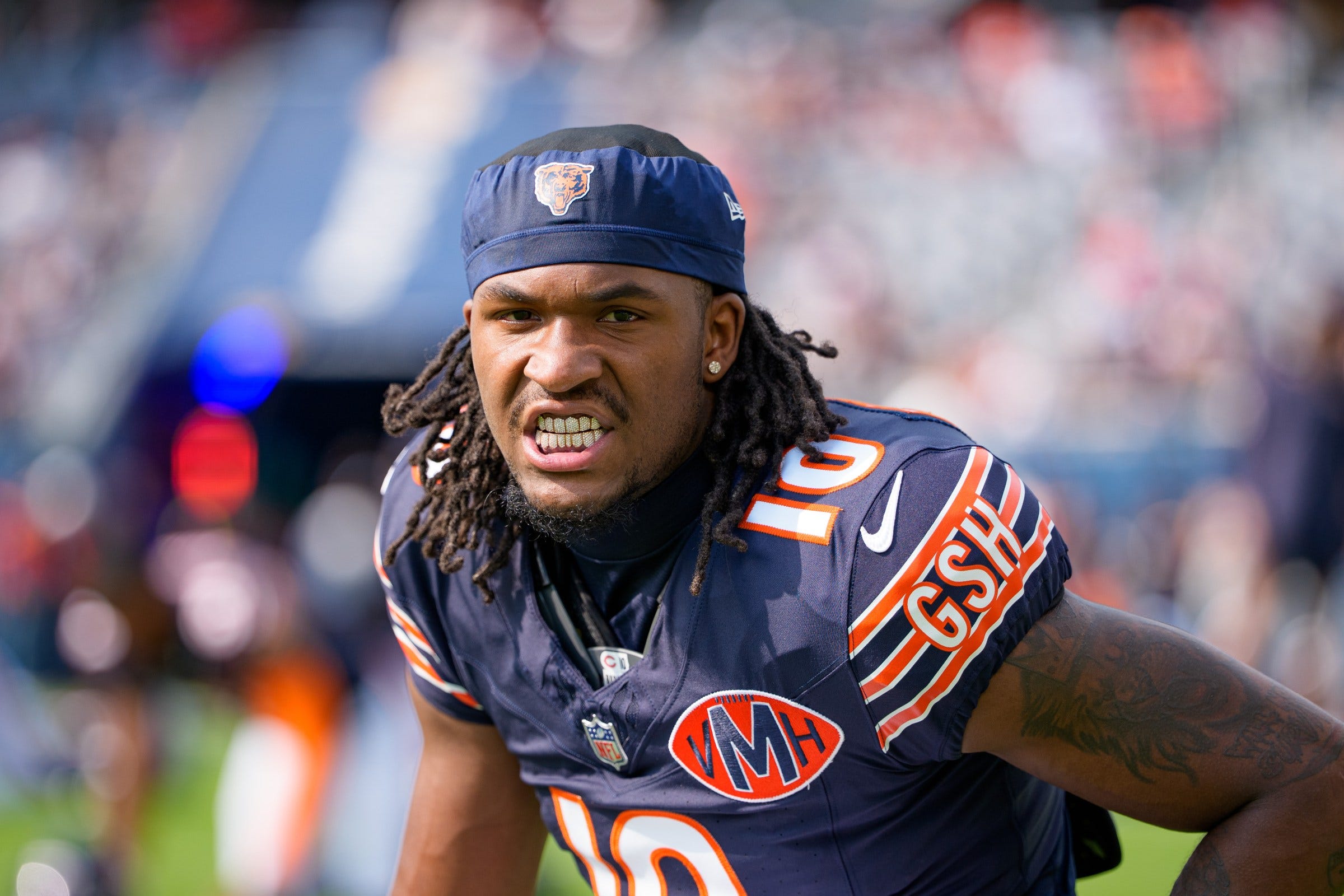
Burden is the most expensive of the trio and likely the most polarizing of the group as well. He serves as the 2026 avatar for an longstanding debate about how much we should value per-opportunity data vs. raw statistical outputs.
Including the playoffs, he posted an elite 23.5% TPRR and 2.34 YPRR — marks that have historically been near guarantees of a successful career when reached by a rookie. However, he never ran more than 70% of his team’s routes in a single game and posted a pedestrian 47-652-2 line overall on a relatively low total of 307 routes (including two playoff games).
Going into 2026 there should be little doubt of whether he’ll have an opportunity to seize a full-time role. The Bears let Olamide Zaccheaus walk and traded D.J. Moore to the Bills without adding a meaningful replacement. Luther Burden projects to play nearly every snap in either 11-personnel or 12-personnel. It’s even possible Burden plays as much or more than Odunze in 13-personnel, given they both played a roughly equivalent amount in these sets last season.


It’s less clear whether Burden would be able to translate his rate of production to a larger role. Part of Burden’s production last season came on schemed touches. It’s a good for a wide receiver to be viewed as dangerous enough in the open field to receive these opportunities, and it’s possible he’ll get a few more with D.J. Moore out of the picture, but these types of touches typically don’t scale up well.
If Ben Johnson wants to call a screen or reverse for Burden, Burden will obviously be on the field for that play no matter what his snap rate is for the whole game. There’s no reason to assume that if we double his routes he’ll automatically receive double the schemed touches. That’s a classic case of selection bias.
However, there is far more to Burden’s profile than schemed touch ability. Burden had a strong college production profile which far out-paced what you’d expect for his draft capital. He also beat both man and zone coverage at solidly above-average rates (league-wide, not just among rookies) in Matt Harmon’s Reception Perception.
In my own tape-watching, I felt Burden was easily the most dynamic receiver in the room last year, with the most suddenness in man-coverage opportunities. He has truly unique movement skills with or without the ball in his hands which give him superstar upside. His deficiencies — both in college and in the NFL — have largely related to staying on assignment and demonstrating consistency play-to-play.
I don’t think there are any talent-based limitations when it comes to Burden. The question is whether that ceiling is well-priced considering the lack of track record and the quality of alternative options in this passing game.
